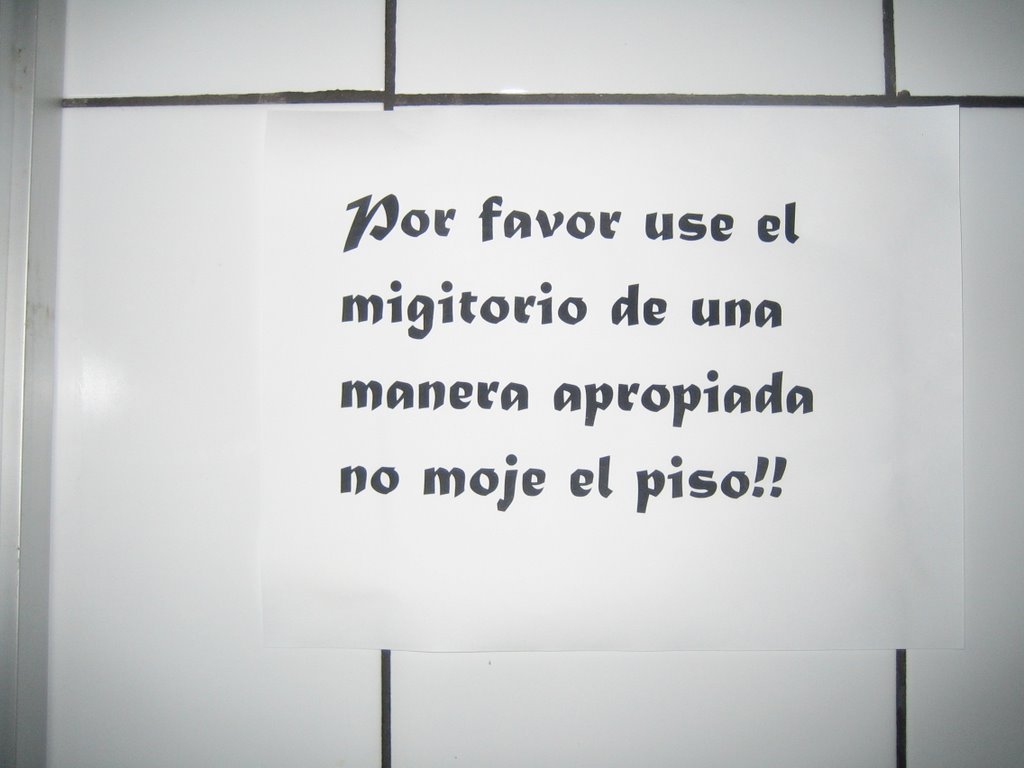
........I will save that pondering for another post.
So on to more important things; I have heard quite a bit of criticism from mis amigos about our posts lately. Some say that they have gotten a little too serious for their liking. Well, too bad! It's our blog, not yours. Start your own blog and write about whatever you want: fast food, cable TV, warm showers, ice in your drinks, hell you can even write about your glutenous desire to read US Weekly (MC, could you write me with more details on Pam and Kid Rock-those crazy kids!) Robert and I are serious people with serious things to share; and just because so many of you infinitelizard critics have been so harsh, we are holding off on Robert's intestinal fortitude piece. A form of punishment, some may say.
So, we are off to hear how the introduction of religion has killed the Mayan culture, and there will be more serious posts to come!
Thursday, August 10, 2006


Dork Alert!
Thanks to Nolan, feedblitz, and my infinite dorkiness (yes, even in foreign countries), I added a feature to the blog that will email you once a day with any new blog posts. That way you (Claire, foodbankcnyers, etc.) don't have to check so much from work. Don't worry, if you are checking to see if you won the translation competition -- which I completely forgot about until just now -- I will put that up as soon as I find the translation.
So I realize this feature is completely unnecessary, but it's also wicked cool. You can sign up on the toolbar on the right.
Enjoy.
So I realize this feature is completely unnecessary, but it's also wicked cool. You can sign up on the toolbar on the right.
Enjoy.
Tuesday, August 08, 2006
Fifty Marathons, Fifty States, Fifty Days
A friend of mine from college, Sam Thompson, is 40 marathons into an event I feel compelled to share. He began July 1st and is running marathons daily for 50 consecutive days, all to raise awareness and funds for Hurricane Katrina Relief efforts. Liz and I were just reading his blog and it is amazing. He is ACTUALLY doing it! It´s worth checking out...
Pictures
We have started to regularly post pictures online. They are stored in our picasaweb account (http://picasaweb.google.com/rcampbell) which is also now linked on the toolbar on the right.
Enjoy!
Enjoy!
Saturday, August 05, 2006
Mary Poppins worked for the Guerillas?
The Guatemalan civil war is a topic that Robert and I are starting to know quite a bit about. It is one thing to read about the effects of war in a history class or see a news channel's perspective on the television, but we are living in the aftermath of an incredibly unjust and complicated civil war that affected thousands of people. And we have the opportunity to hear what those people think and feel about the war and Guatemala today, first hand. To read more about the war click here.
Two particular personal stories come to mind and I am having a hard time processing, or I guess believing, that humanity can be so raw and cruel. I feel like I need to pass on these stories, and be a voice for those who should be heard.
Story 1
This past Wednesday Bert and I ventured to an organization called Entre Mundos, a volunteer coordination hub, to hear a torture victim from the Civil War share his story. The conference was held in a modest courtyard, which is very common in the colonial-style buildings of historic zone 1. There were plastic chairs and wood benches placed around a "stage" where two stools and a table sat, which were for the speaker and his translator. The speaker, whose name was Pedro, looked like he was close to 80 years old, but, like many Guatemalans, he looked much older than he actually was. His face looked weathered as if he had spent many long days working on his land unshielded from the sun; he wore blue jeans, work boots, and an old-school green Celtics jacket. He looked kind and very timid.
We spent the next 2 hours listening to him retell his painful experience in great detail. There were times that he held his head in his hands as if he couldn't bear to spend another second reliving those moments. But, he always continued and it was difficult to hear what he had to say. He lived in a small indigenous village in the mountains of Guatemala. He was the coordinator of a large farming co-op and had no ties to either side of the civil war. It was common practice for the Guerrillas (the rebels) to demand food and shelter (among other things) at gun point and for the government to consider those who obliged the guerrillas' "requests" as conspirators. Many innocent people died at the hands of both sides not knowing what either of them were even fighting over. And many of those people happened to be indigenous.
One day the military came to his small village and demanded that he come with them. He didn't know why they chose him or where he was going. The tied him up, stripped him of his clothes, and threw him in the back of a military vehicle. That was the beginning of his torture. He endured rounds of beatings and interrogations; sometimes he went days without water or food. The military was convinced he was a rebel and wanted him to divulge his co-conspirators. But, he wasn't a rebel, and he refused to give up innocent persons' names. The beatings continued. They bit his ear, spit on him, and stabbed him with knives. Still, he endured. After months of this treatment, he was released and returned to his village. However, he did not feel safe and was not accepted by his neighbors. He left by foot to live in Mexico and left his property and family behind. He returned to Guatemala in 1998, but couldn't return to his land or village. He now lives in a village composed mostly of refugees from the war. And 8 years later, he still hasn't seen retribution (monetarily) from the government.
Story 2
During the war, my teacher joined an organization that worked to reestablish war-torn areas. Among many projects, they created schools and cultivated crops. Miriam worked there for two years before she realized that this "organization" was really a front for the guerrilla forces. After learning of this facade, she started to get to know some of the women in the village better. Many of them were living in the mountains hiding from the military. And among the many difficult decisions they had to make, they often had to choose between leaving the protection of the guerrillas to raise their children or to "dispose" of the children. Miriam said she knew many women who became pregnant and either had an abortion or smothered their child at birth in order to stay within the protected group.
Miriam continued to work teaching children Spanish lessons and found herself well known by the organization's top authorities. They recognized her commitment and talent and felt compelled to harness her skills for use in the war. She continually received pressure to leave the country to train in Cuba where, on her return, she could join the guerrilla forces. Miriam, at the time, had young children and used that as her defense against the training. Needless to say, she left the group shortly after the pressures became threatening.
These stories only begin to scratch the surface of the thousands of stories that exist in post-war Guatemala. I hope to learn more about the war and to continue to share those stories....
Chichicastenango
As you might have noticed, we are a bit slow to post much of anything to this blog of ours. Mostly, that is because after having five hours of classes every morning, we typically have mucha tarea (lots of homework). When both are completed, our brains are fried and we need mental down time. That being said, we have gone on some fabulous weekend (and weekday) excursions in and around Xela that we will try to share. As it decided to rain this afternoon before tonight's home opener for the Xelaju Super Chivas (local futbol team), we decided to share...
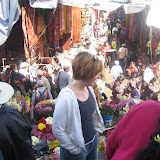
One such was two weekends ago to the town of Chichicastenango (or Chichi to us gringos). Chichi is first and foremost known for its biweekly market which is said to be the most colorful in Guatemala, Central Amercia and possibly all of the Americas. The town has been a dominant trading hub in the largely Mayan area for centuries and it was overwhelmingly impressive. Market days are Thursday and Sunday and they are packed -- so much so that many friends recommended you go the night before in order to be up for the early morning (4am!) sales by candlelight.
A bit of backround again from Wikipedia (very similar and much easier that typing from our guidebook)...
Our school organized the outing and there were maybe 25 other people with us. The travel in the two private microbuses (squatty minivan type vehicles you don't see in the states) was a "trip" in itself and makes us really look forward to riding chicken buses all over Central America! We were winding through the mountains on a two lane road, mostly well paved, and passing other cars/trucks/bikes at will. And the passing system here is a bit different than what we might be used to, or shall I say one that we are "comfortable" with. Think of those pretty double yellow lines in two lane highways that are conveniently dotted when someone decided it is safe to pass -- or solid yellow lines advising against it....they may even have some legality attached to them in the states.
Okay, now forget about pretty yellow lines, add lots of turns on mountain roads, little use of the brakes at any point, lots of honking, and one of the teachers pops in a CD and on the radio starts blasting none other than -- Highway to Hell!! I promise I'm not making this up. I actually got out my camera to take short video to document the insane irony. Fortunately, the 80s jam continued for an entire CD which we jammed to for a good portion of the 4 hour trip. How fitting a start!
We arrived safely in Chichi and had about 4 hours to wander, look, smell, and, of course, bargain. It seems to be the way things go. The vendors really are talking/yelling at anyone who passes, but particularly to foreigners. As expected, the experience came with mixed emotions. It is partly invigorating (and fun!) to really bargain and feel very much a part of the centuries old market system, but it is simultaneously disheartening as they lowered their prices again and again.
Still very ignorant of the economy, it is hard to know just what was behind it all. When she lowered the price of a table runner from 700Q to 400Q without our saying anything at all but only by starting to walk away, does it show the level of inflation that comes with our skin or just how much they need the money? Did the few dollars we paid for shirts and a bag cover the production costs? What exactly are "production costs" here anyway? Outside of material costs, how is an individual's labor value determined? Does it depend more on how much money they need at the time of the sale than the countless hours that went into the beautifully hand woven crafts?
So much more to learn...
We were fortunate enough that in the next week, the school also organized a weaving demonstration and testimony from a local women's cooperative. It helped give insight into the artisan culture. More on that later. For now, enjoy the pictures of Chichicastenango...
One such was two weekends ago to the town of Chichicastenango (or Chichi to us gringos). Chichi is first and foremost known for its biweekly market which is said to be the most colorful in Guatemala, Central Amercia and possibly all of the Americas. The town has been a dominant trading hub in the largely Mayan area for centuries and it was overwhelmingly impressive. Market days are Thursday and Sunday and they are packed -- so much so that many friends recommended you go the night before in order to be up for the early morning (4am!) sales by candlelight.
A bit of backround again from Wikipedia (very similar and much easier that typing from our guidebook)...
The market and experience was wonderful and it really is as colorful and erratic as it sounds. Pictures are below, but a bit about the trip overall...The famous handicraft market of Chichicastenango draws not only the K'iche' Maya of the surrounding region, but vendors from all over Guatemala. They represent many of Guatemala's linguistic groups: Mam, Ixil, Kaqchikel, and others (Guatemala has 23 indigenous languages). Each person hawks his or her products in a cacophony of color, dialects, costumes, smoke, and smells.
Vendors start setting up their own portable booths in the main plaza and nearby streets of Chichicastenango the night before and set-up continues into the early daylight hours. Although it is sometimes not immediately apparent, the market is very well organized. Vendors of specific types of items occupy traditional places in the market. The fruit and vegetable vendors have their traditional area that they occupy, as well as the vendors of pottery, wooden boxes, condiments, medicinal plants, candles, pom and copal (traditional incense), cal (lime for preparing tortillas), grindstones, pigs and chickens, machetes, and other tools. In the central part of the market plaza are comedores (small eateries, which tourists are advised not to eat at).
Among the items sold are textiles, particularly the women's blouses. The manufacture of masks, used by dancers in traditional dances has also made this city famous for woodcarving. Much of what is sold is of good quality, but there are also products in Chichicastenango's many factories for the not-so-discerning foreign
companies.Early in the day, homemade rockets and firecrackers are set off and continue randomly throughout the day. The smell of incense burned at the church of Santo Tomás (on the steps and in the nave) and fireworks mingle together.
Our school organized the outing and there were maybe 25 other people with us. The travel in the two private microbuses (squatty minivan type vehicles you don't see in the states) was a "trip" in itself and makes us really look forward to riding chicken buses all over Central America! We were winding through the mountains on a two lane road, mostly well paved, and passing other cars/trucks/bikes at will. And the passing system here is a bit different than what we might be used to, or shall I say one that we are "comfortable" with. Think of those pretty double yellow lines in two lane highways that are conveniently dotted when someone decided it is safe to pass -- or solid yellow lines advising against it....they may even have some legality attached to them in the states.
Okay, now forget about pretty yellow lines, add lots of turns on mountain roads, little use of the brakes at any point, lots of honking, and one of the teachers pops in a CD and on the radio starts blasting none other than -- Highway to Hell!! I promise I'm not making this up. I actually got out my camera to take short video to document the insane irony. Fortunately, the 80s jam continued for an entire CD which we jammed to for a good portion of the 4 hour trip. How fitting a start!
We arrived safely in Chichi and had about 4 hours to wander, look, smell, and, of course, bargain. It seems to be the way things go. The vendors really are talking/yelling at anyone who passes, but particularly to foreigners. As expected, the experience came with mixed emotions. It is partly invigorating (and fun!) to really bargain and feel very much a part of the centuries old market system, but it is simultaneously disheartening as they lowered their prices again and again.
Still very ignorant of the economy, it is hard to know just what was behind it all. When she lowered the price of a table runner from 700Q to 400Q without our saying anything at all but only by starting to walk away, does it show the level of inflation that comes with our skin or just how much they need the money? Did the few dollars we paid for shirts and a bag cover the production costs? What exactly are "production costs" here anyway? Outside of material costs, how is an individual's labor value determined? Does it depend more on how much money they need at the time of the sale than the countless hours that went into the beautifully hand woven crafts?
So much more to learn...
We were fortunate enough that in the next week, the school also organized a weaving demonstration and testimony from a local women's cooperative. It helped give insight into the artisan culture. More on that later. For now, enjoy the pictures of Chichicastenango...
Thursday, August 03, 2006
I HUFFED and I PUFFED and...
(Don't worry, the volcano story and a few others are still in the works as we sort through some photo storage obstacles...thanks Teesh!)
So last Friday we got home from school at the usual time, around 1:15pm just in time for lunch. We removed the padlock from our bedroom door and pushed. Nothing. We pushed a little harder and gave it a good shake. Nothing. The door would not open. We looked at each other and laughed, knowing that the other door into our room from the courtyard was definitely locked from the inside.
Liz went to get Martha while I tried to see what might be keeping it from opening. I could hear Liz in the kitchen where Martha and Angela were preparing lunch: "Yo tengo uno problema con la puerta." Remember the post about the Terrible Two's?? As is often the case, it was an amuzing (and quick!) conversation.
Luckily, we are REALLY good at charades these days and Liz and Martha soon returned. I stepped aside and Martha, our four foot six inch host mother, stepped up to the plate. Now Martha is adorable and has graciously opened her home to us for these past three weeks....but this was hilarious. She grabbed the little handle and just started shaking away -- head swaying with each shake, jewelry clanking -- she really gave it her all.
Nothing. Door still closed....more laughter.
Off they go again, headed somewhere to get something that would hopefully help us get into our room. I checked out the door just a bit more and it appeared to my Handyman eye that the door had been pulled shut harder than usual and the lock on the door itself was pushing on the doorframe. I just need to push a little harder...yeah, that will do it...
One more good push and, sure enough, the door opened. And with it came the door frame and large chunks of the sheetrock-like wall crumbling to the floor! Uh-oh...
So last Friday we got home from school at the usual time, around 1:15pm just in time for lunch. We removed the padlock from our bedroom door and pushed. Nothing. We pushed a little harder and gave it a good shake. Nothing. The door would not open. We looked at each other and laughed, knowing that the other door into our room from the courtyard was definitely locked from the inside.
Liz went to get Martha while I tried to see what might be keeping it from opening. I could hear Liz in the kitchen where Martha and Angela were preparing lunch: "Yo tengo uno problema con la puerta." Remember the post about the Terrible Two's?? As is often the case, it was an amuzing (and quick!) conversation.
Luckily, we are REALLY good at charades these days and Liz and Martha soon returned. I stepped aside and Martha, our four foot six inch host mother, stepped up to the plate. Now Martha is adorable and has graciously opened her home to us for these past three weeks....but this was hilarious. She grabbed the little handle and just started shaking away -- head swaying with each shake, jewelry clanking -- she really gave it her all.
Nothing. Door still closed....more laughter.
Off they go again, headed somewhere to get something that would hopefully help us get into our room. I checked out the door just a bit more and it appeared to my Handyman eye that the door had been pulled shut harder than usual and the lock on the door itself was pushing on the doorframe. I just need to push a little harder...yeah, that will do it...
One more good push and, sure enough, the door opened. And with it came the door frame and large chunks of the sheetrock-like wall crumbling to the floor! Uh-oh...
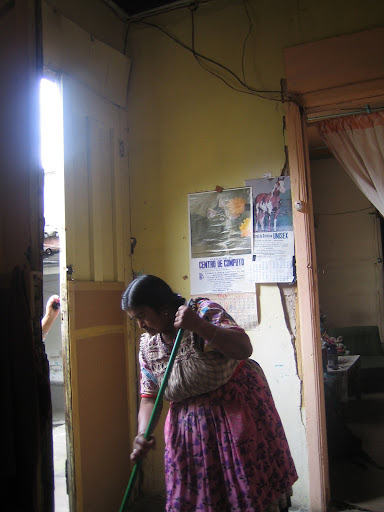
Whoops!
A few seconds later Martha and Liz, ignorant of the events that just took place, come leisurely around the corner. I was still standing in the doorway, mouth wide open and stunned that there were actually pieces of the wall around my feet. I felt horrible.
Liz, attempting to console her saddened husband, proceeded to fall on the floor laughing. Martha took a moment to assess the situation before joining in...whew! Angela, hearing all of the commotion, came to see what was going on and, of course, joined in.
I can't tell you how many times I said "lo siento" the rest of the day. But Martha just took it in stride and told us that the next morning she would go talk to the carpenter across the street while we were on our Volcanic adventure (Of course the carpenter lives across the street...but hopefully she didn't feel the need to see the lawyer next door to him.)
It made for a lively conversation at lunch, during which I earned the nickname "super hombre" among others. Angela continues to make fun of me to this day.
When we got back from the Volcano on Saturday afternoon, the door frame and wall had already been repaired. All things considered, minor costs for a great story.
 all better!
Saturday, July 29, 2006
Have you ever been lost on a Volcano?
Well, you wouldn´t be alone!
Actually, in the end we weren´t actually lost. But for the last hour of our 4 hour descent, we were absolutely convinced we had taken a wrong turn half way down and were headed in the wrong direction to an unknown town. We have still never used a telephone nor did we really know if we would actually be able to get in touch with the guide company that we´d taken for the trip. (yeah, our guide was somewhere behind us with the last few of our 8 person group.)
Oh, and we tried with relative success to ask a farmer on the mountain if he had seen any gringos pass by earlier. Despite his saying yes (plus lots of other things we might have understood), from the description it sounded like another group on the mountain that day.....feeding the lostness...
It´s now 5:05pm and we just got dropped back off at the school just a bit late (we were supposed to be done at 1pm!).
We´re COMPLETELY EXHAUSTED and pretty dirty. (picture at least a 45 degree incline the entire way, lots of boulder hopping, LOTS of mud on washed out trails...and it rained most of the way down)
We´re headed home to shower (we were told there´s only hot water early in the mornings and late at night...sweet!) and then to meet our fellow moutain climbing friends for dinner.
More on this later...
Actually, in the end we weren´t actually lost. But for the last hour of our 4 hour descent, we were absolutely convinced we had taken a wrong turn half way down and were headed in the wrong direction to an unknown town. We have still never used a telephone nor did we really know if we would actually be able to get in touch with the guide company that we´d taken for the trip. (yeah, our guide was somewhere behind us with the last few of our 8 person group.)
Oh, and we tried with relative success to ask a farmer on the mountain if he had seen any gringos pass by earlier. Despite his saying yes (plus lots of other things we might have understood), from the description it sounded like another group on the mountain that day.....feeding the lostness...
It´s now 5:05pm and we just got dropped back off at the school just a bit late (we were supposed to be done at 1pm!).
We´re COMPLETELY EXHAUSTED and pretty dirty. (picture at least a 45 degree incline the entire way, lots of boulder hopping, LOTS of mud on washed out trails...and it rained most of the way down)
We´re headed home to shower (we were told there´s only hot water early in the mornings and late at night...sweet!) and then to meet our fellow moutain climbing friends for dinner.
More on this later...
Friday, July 28, 2006
"The Terrible Two's"
We met this incredibly interesting young women here in Xela who is an anthropology major at Stanford University; I believe her name was Julia. So, Julia explained to us that children who are developing their language skills often know what they want to say well before they can actually say it. This explains why children who have entered their "terrible two's" tend to act out. They just can't communicate to those around them and they are frustrated. Hmmm.... OK, fast forward 28 years, add one Spanish language immersion, and only two weeks of classes. Hey, wait a second...
This week I changed teachers and started fresh with a new maestra. Her name is Miriam and she would be the ideal character for the reality TV show Nanny 911--Xela. Picture Mary Poppins, got it? OK, now think shorter, stockier, more strict, and with a thick Guatemalan accent. Love her.
Monday morning, Miriam and I started at 8:00 am on the dot without wasting any time. We covered regular verbs, irregular verbs, prepositions, interrogatives, and much more. My head was spinning; I desperately tried to absorb, process, and regurgitate all the information correctly. Needless to say, it was muy dificil. She gave me about two more hours of homework and sent me on my way.
Tuesday morning, Miriam and I started at 8:00 am on the dot without wasting any time. We covered contractions, sentence structure, gender of articles, and much more. At one point, we took a break so that she could go to el baño. To avoid wasting one second of instruction time, Miriam RAN across the courtyard to the bathroom and ran back. The woman was a machine. Once again, I tried to absorb, process, and regurgitate all the information correctly. She gave me about three hours of homework and sent me on my way.
Wednesday morning, Miriam and I started at 8:00 am on the dot without wasting any time. We tried to cover reflexive verbs, adjectives, and vocabulary. Miriam sensed that I was a little overwhelmed and she quickly changed the plan for the day. I was going to work on pronunciation. She asked me to read a few paragraphs to her. At first I did well, but slowly my mind couldn't distinguish between English and Spanish pronunciation and finally I found myself stuck at the word contribuye. It was so difficult to read that I completely stopped at the word. On my first attempt I completely butchered the pronunciation. Miriam giggled and asked me to try again. No luck, butchered again. She slowly read the word to me and I desperately contorted my mouth and tongue to create the correct sequence in Spanish, but with no avail. I had actually lost the ability to speak. And in my regression found myself turning red, holding my breath, clenching my fists, and wanting to cry out. I was trying so hard. I knew what I wanted to say, but just couldn't do it!
Miriam, being the excellent teacher that she is, asked me if I wanted to take a walk. Wow! I must have really looked frustrated to compel Miriam to waste any class time. She went to the office grabbed a book and we walked to the park nearby. When we reached the park, Miriam pulled out the book for me to use. At first, I thought she may have been kidding, but when I saw her face, I knew this was no joke. The book was very small and the pages were made of thick corrugated cardboard. The words were written in brilliant colors and the letters must have been at least a 20 point font. Each page had one letter of the alphabet and four words to demonstrate the sound of that particular letter. It was one step away from being one of those waterproof books that babies can bring in the bath with them. I spent the next hour, at Miriam's insistence, practicing the pronunciation of the letters of the alphabet. As I read the letters aloud, I couldn't help but wonder what the other people in the park were thinking. The thought was so amusing that I wanted to laugh so badly, but didn't for fear of upsetting my no-nonsense teacher. There I was, 30 years old, reading the alphabet in the middle of a public park in Xela. I have had many humbling experiences during our travels, but this was absolutely hilarious.
I hope I take away a very important lesson from Julia and my experience with learning a new language. When Robert and I do become parents some day, I hope we recognize that there will be many times that our children will be just as frustrated trying to communicate with us as we are with them. I would love to hear more opinions from the many new and experienced parents that read our blog.
Best,
Humbled in Guatemala
This week I changed teachers and started fresh with a new maestra. Her name is Miriam and she would be the ideal character for the reality TV show Nanny 911--Xela. Picture Mary Poppins, got it? OK, now think shorter, stockier, more strict, and with a thick Guatemalan accent. Love her.
Monday morning, Miriam and I started at 8:00 am on the dot without wasting any time. We covered regular verbs, irregular verbs, prepositions, interrogatives, and much more. My head was spinning; I desperately tried to absorb, process, and regurgitate all the information correctly. Needless to say, it was muy dificil. She gave me about two more hours of homework and sent me on my way.
Tuesday morning, Miriam and I started at 8:00 am on the dot without wasting any time. We covered contractions, sentence structure, gender of articles, and much more. At one point, we took a break so that she could go to el baño. To avoid wasting one second of instruction time, Miriam RAN across the courtyard to the bathroom and ran back. The woman was a machine. Once again, I tried to absorb, process, and regurgitate all the information correctly. She gave me about three hours of homework and sent me on my way.
Wednesday morning, Miriam and I started at 8:00 am on the dot without wasting any time. We tried to cover reflexive verbs, adjectives, and vocabulary. Miriam sensed that I was a little overwhelmed and she quickly changed the plan for the day. I was going to work on pronunciation. She asked me to read a few paragraphs to her. At first I did well, but slowly my mind couldn't distinguish between English and Spanish pronunciation and finally I found myself stuck at the word contribuye. It was so difficult to read that I completely stopped at the word. On my first attempt I completely butchered the pronunciation. Miriam giggled and asked me to try again. No luck, butchered again. She slowly read the word to me and I desperately contorted my mouth and tongue to create the correct sequence in Spanish, but with no avail. I had actually lost the ability to speak. And in my regression found myself turning red, holding my breath, clenching my fists, and wanting to cry out. I was trying so hard. I knew what I wanted to say, but just couldn't do it!
Miriam, being the excellent teacher that she is, asked me if I wanted to take a walk. Wow! I must have really looked frustrated to compel Miriam to waste any class time. She went to the office grabbed a book and we walked to the park nearby. When we reached the park, Miriam pulled out the book for me to use. At first, I thought she may have been kidding, but when I saw her face, I knew this was no joke. The book was very small and the pages were made of thick corrugated cardboard. The words were written in brilliant colors and the letters must have been at least a 20 point font. Each page had one letter of the alphabet and four words to demonstrate the sound of that particular letter. It was one step away from being one of those waterproof books that babies can bring in the bath with them. I spent the next hour, at Miriam's insistence, practicing the pronunciation of the letters of the alphabet. As I read the letters aloud, I couldn't help but wonder what the other people in the park were thinking. The thought was so amusing that I wanted to laugh so badly, but didn't for fear of upsetting my no-nonsense teacher. There I was, 30 years old, reading the alphabet in the middle of a public park in Xela. I have had many humbling experiences during our travels, but this was absolutely hilarious.
I hope I take away a very important lesson from Julia and my experience with learning a new language. When Robert and I do become parents some day, I hope we recognize that there will be many times that our children will be just as frustrated trying to communicate with us as we are with them. I would love to hear more opinions from the many new and experienced parents that read our blog.
Best,
Humbled in Guatemala
Saturday, July 22, 2006
Feliz Neuva Año!!
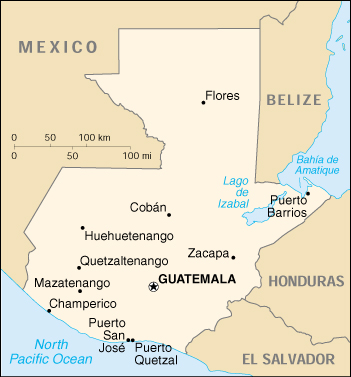 Quetzeltanango, Guatemala, the city we now call home, is located in the Western Highlands of Guatemala, almost four hours due east of the capital, Guatemala City. Primarily known by its Mayan name of Xela (shay-la), the city and highlands area are home to a significant Mayan population -- well over 50%. We're slowly learning bits and pieces of the rich history of the city, region and country. It's quite fascinating really. Particularly the part about the 36 year civil war that ended in 1996, the history of agriculture exports, all seeming to be under the strong "influence" of US foreign policy inthe area. We saw at least a dozen books in a book store yesterday about the CIA's presence in Guatemala alone...there are lots of stories of US backing of various militia and guerilla groups. Okay, so we have a lot to learn and it's happening slowly but surely...little bits here and there from our teachers or from the weekly "conferencias" (lectures). We will continue to share...
But back to the New Year!!
On Monday, July 17 the Mayan New Year began. Our school celebrated the occasion with a traditional Mayan ceremony, complete with decorations around the school. Classes ended early in the morning, making time for the 2 hour ceremony that was performed by four Mayan priests. It was a fascinating experience. Greta, the student coordinator at our school (she's from somewhere in the states), translated the majority of the ceremony.
Mayan years are based around a calendar of 260 days, which are divided into 13 day segments that each represent one of 20 dieties (here are the names thanks to wikipedia). We all gathered around a makeshift fire ring out in a garden area behind the school. We took lots of pictures throughout to at least capture images if we can't remember all of the ceremonial aspects! It started with the priests slowly building the fire with various (flamable) objects, each with a special significance: sugar, flowers, multiple colored candles (lots of candles), charcoal, chocolate, candies, tobacco, and a few other things.
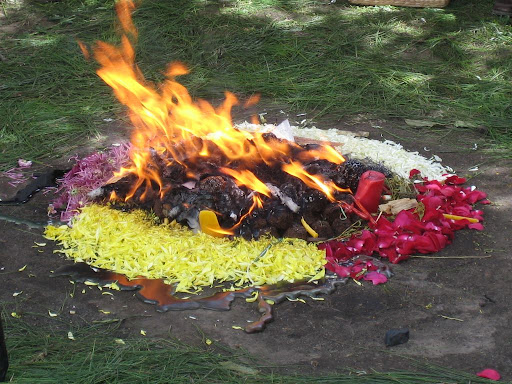
Once the fire was lit, the ceremony celebrated each of the 20 dieties with a special chant followed by offerings (candles tossed into the flames) by those in attendance. As you will see from the pictures, the pyro in me came out and I started to become a bit mezmorized by the fire. It was a very peaceful ceremony -- giving thanks to the air, earth, wind and water and all that they allow in our lives. Sure, it's quite different than what we were used to on Sunday mornings at Government Street Presbyterian or St. Patrick's (it was in a different language and around a big fire with "offerings"), but in many ways it felt familiar as there were common themes to be celebrated.
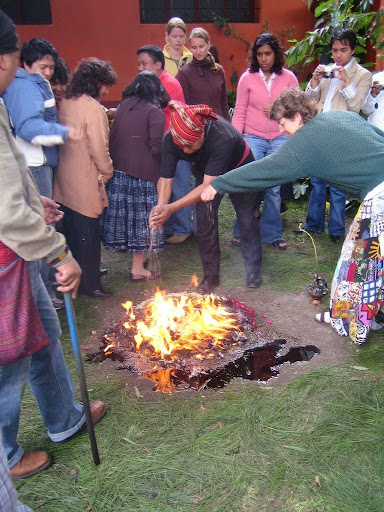
Click here for the entire set of pictures from the ceremony. Enjoy!
Thursday, July 20, 2006
Sunday, July 16, 2006
What's White and Red and Consumed All Over....
COKE!
Soda consumption in Xela is completely unimaginable. And it's not just Coke. Remember Fanta? Orange Crush? Yeah, me neither. I thought it had lost its place in the current soda market. Nope, I was wrong. It is here in Xela and prospering.
Today, we went to a soccer game to watch the local team play an exhibition match. It was so much fun to sit in the stands with the locals and cheer for Xelaju. But, as I looked around I couldn't help but be distracted by the number of people sucking down 32 oz containers of soda. It led me to wonder-- what is the rate of tooth decay and bone fractures in children in Guatemala? Right, I know, but I AM a Dietitian. So, I did a little research and found this little quote. I intend to look into this matter further, but thought I would share this for now.
"If the cultural, health and economic problems with Coke's colonization of Latin America weren't bad enough, it also has a labor record that puts even most other multinational companies to shame. In Guatemala and Colombia, there is strong evidence that the Coca-Cola company actively supported the murders of union activists by paramilitary members at bottling plants run by its subsidiaries and contractors over the years. In Mexico, El Salvador and other countries there have also been ample allegations of the company using paramilitary strength to prevent unionizing and keep employees in line.
In 2001, Human Rights Watch (HRW) and the United Auto Workers (UAW) filed a lawsuit against Coke for the murder of union activist Isidro Gil Segundo and an ongoing campaign of intimidation, terror, murder and paramilitary activity against union members and leaders. Across the board, Coke and its Latin American bottling partners, including Panamco and Bebidas y Alimentos, have waged vicious anti-union campaigns and been accused of rampant illegal labor practices, intimidation techniques, unfair firings and physical attacks.
... Today, Coca-Cola plainly stands as an unvarnished symbol of neoliberalism and modern corporate mercantilism. It is, plainly said, a multinational corporation exploiting cheap labor and "emerging markets," that employs an array of illegal and criminal business "strategies," and utilizes powerful public relations, marketing and lobbying powers to avoid accountability and fatten the company's profits just as its product fattens its consumers."
— Kari Lydersen, Sugar and Blood: Coke in Latin America, Lip Magazine, 28 May 2002
Saturday, July 15, 2006
¿Tu quieres morir?
(I think I just threatened to kill our host mother!)
After that first day of unfortunate experiences, things have already started to turn around.
We had Wednesday morning to get settled into our new surroundings before starting classes in the afternoon. We took a nice walk through Parque Central in the brisk morning air (more on this later) before making our way to a bookstore. Well stocked and connected to a cute cafe, we loaded up on some fundamentals: a new Lonely Planet guidebook to Central America (yes, the same one we left in the states), a used book on Guatemalan history and culture, two notebooks for class, and a few stacks of flashcards. It was only 11am and the day was going well!
We walked back through the park and saw that the infamous cafe was finally open. We entered with our prepared statement...
Encontras una toalla ayer? (Do you find a towel yesterday? We haven´t made it to past tense yet.)
Of course, our question prompted a response. We understood little, but nodded along incessantly after hearing "black" bag thrown in at some point. We looked desperate and threw in some charades to show where we´d been sitting the day before. It seemed to be working! The nice woman went behind the counter and made a quick telephone call, then returned with our lost black bag. Minnie was found!
On to school...
Classes are Monday - Friday of one-on-one instruction for five hours per day. Because the school was maxed out in the mornings with over 50 students, we had afternoon classes from 2-7pm for the first two days. They have been excellent so far, and they certainly weren´t kidding when they billed this as an immersion experience. Both of our teachers are extremely nice and welcoming, but they don´t speak a lick of English! If I understood my teacher, Carmen, correctly on that first day (not a certainty) , the school intentionally seeks teachers that do NOT speak English. It was a bit shocking on the first day, but we have come to appreciate it more and more. It´s truly amazing how far we have come after only three days.
But let´s make sure to put this in context...
We´ve only been here THREE DAYS and we had virtually no Spanish background (none at all for Liz and only 3 touch college semesters for me years ago). So learning even the most basic round of questions and key vocabulary has helped immensely, particularly with mealtime conversations. But we are also still relegated to the present tense, our pronunciation needs serious work, and clearly we need to spend more time with the flashcards. Hence, the title of the post.
As our vocabulary and comfort levels increase, we use our mealtime conversations with Martha (reminder: she doesn´t speak English either) as testing ground for our new material. So today, after spending some time with the flashcards in the morning, we decided we were ready to bring out our photo album after lunch. It went something like this...
Roberto: Nosotros tenemos pictures (in my best Spanish accent)
Martha: (blank look)
Roberto & Liz: (switching into charades mode, start pointing at pictures on the wall) Picture? ... Picture?
Martha: Ah, fotos!
Roberto: Si. Si. Fotos! Lo siento. Nosotros tenemos fotos de nuestra casa y familias en el cuarto. (We have pictures of our house and families in our bedroom.)
Martha: Ah, bueno!
(Success! But then Disaster...)
Roberto: Tu quieres morir?
Martha: (brilliantly blue shadowed eyes grow large with look of concern) Morir?!?
Liz: No! No! No morir, mirar!
Roberto: Lo siento! Lo siento! Tu quieres mirar?
mirar = to see
morir = to die!
Whoops! I guess it´s time to study the flashcards again!
Luckily, it led to a great conversation with Martha. After seeing the few pictures we had, she pulled out hundreds of family pictures to share with us. It was nice learning more about her family and her past.
All in all, we had a great afternoon...until the battles of intestinal fortitude interrupted. We´ll save that for later...
After that first day of unfortunate experiences, things have already started to turn around.
We had Wednesday morning to get settled into our new surroundings before starting classes in the afternoon. We took a nice walk through Parque Central in the brisk morning air (more on this later) before making our way to a bookstore. Well stocked and connected to a cute cafe, we loaded up on some fundamentals: a new Lonely Planet guidebook to Central America (yes, the same one we left in the states), a used book on Guatemalan history and culture, two notebooks for class, and a few stacks of flashcards. It was only 11am and the day was going well!
We walked back through the park and saw that the infamous cafe was finally open. We entered with our prepared statement...
Encontras una toalla ayer? (Do you find a towel yesterday? We haven´t made it to past tense yet.)
Of course, our question prompted a response. We understood little, but nodded along incessantly after hearing "black" bag thrown in at some point. We looked desperate and threw in some charades to show where we´d been sitting the day before. It seemed to be working! The nice woman went behind the counter and made a quick telephone call, then returned with our lost black bag. Minnie was found!
On to school...
Classes are Monday - Friday of one-on-one instruction for five hours per day. Because the school was maxed out in the mornings with over 50 students, we had afternoon classes from 2-7pm for the first two days. They have been excellent so far, and they certainly weren´t kidding when they billed this as an immersion experience. Both of our teachers are extremely nice and welcoming, but they don´t speak a lick of English! If I understood my teacher, Carmen, correctly on that first day (not a certainty) , the school intentionally seeks teachers that do NOT speak English. It was a bit shocking on the first day, but we have come to appreciate it more and more. It´s truly amazing how far we have come after only three days.
But let´s make sure to put this in context...
We´ve only been here THREE DAYS and we had virtually no Spanish background (none at all for Liz and only 3 touch college semesters for me years ago). So learning even the most basic round of questions and key vocabulary has helped immensely, particularly with mealtime conversations. But we are also still relegated to the present tense, our pronunciation needs serious work, and clearly we need to spend more time with the flashcards. Hence, the title of the post.
As our vocabulary and comfort levels increase, we use our mealtime conversations with Martha (reminder: she doesn´t speak English either) as testing ground for our new material. So today, after spending some time with the flashcards in the morning, we decided we were ready to bring out our photo album after lunch. It went something like this...
Roberto: Nosotros tenemos pictures (in my best Spanish accent)
Martha: (blank look)
Roberto & Liz: (switching into charades mode, start pointing at pictures on the wall) Picture? ... Picture?
Martha: Ah, fotos!
Roberto: Si. Si. Fotos! Lo siento. Nosotros tenemos fotos de nuestra casa y familias en el cuarto. (We have pictures of our house and families in our bedroom.)
Martha: Ah, bueno!
(Success! But then Disaster...)
Roberto: Tu quieres morir?
Martha: (brilliantly blue shadowed eyes grow large with look of concern) Morir?!?
Liz: No! No! No morir, mirar!
Roberto: Lo siento! Lo siento! Tu quieres mirar?
mirar = to see
morir = to die!
Whoops! I guess it´s time to study the flashcards again!
Luckily, it led to a great conversation with Martha. After seeing the few pictures we had, she pulled out hundreds of family pictures to share with us. It was nice learning more about her family and her past.
All in all, we had a great afternoon...until the battles of intestinal fortitude interrupted. We´ll save that for later...
Wednesday, July 12, 2006
Bienvenidos a Xela!
Some thoughts from last night...
July 11, 2006
9:15pm
Our first full day is officially ending as we´ve returned to our humble little room and climbed into bed. We had a much needed conversation and are beginning to find words to articulate just what we are experiencing.
In the summer of 1999, after my Sophomore year at Rhodes, I took a trip halfway around the world to the small yet infamous country of Nepal. About ten days into my trip, as I was desperately trying to rescue my mind and body from depression, isolation and generally being overwhelmed, I made myself a promise -- one that would ultimately help turn that trip into an overwhelmingly positive life-changing experience.
I promised myself that no matter how far I pushed myself outside of my comfort zone -- no matter how utterly overwhelming those first 10 days had been in Nepal as I struggled with the harsh reality of third world poverty -- as my worldview was being shattered with each passing moment in ways even the most eloquent authors and guidebooks could not prepare me for...
I promised myself that I would not back down. I would not let my fear and discomfort in those circumstances force me back into my shell. I would hold my head up, keep my eyes wide open, and seize the day.
But more than that, I promised myself to be intentional and reflective about what I was feeling. I wanted to particularly remember the struggles, mentally and emotionally, that I felt were strong enough to qualify (at least in grandiose writing) as worldview shattering. Because I knew there was great potential to look back on those first 10 days at the end of all 60 and think they weren´t all that difficult -- that I was overreacting and simply a naive, wealthy, privileged, white American who couldn´t grasp *real* poverty. I wanted to remember my struggles and let them remain active in my memory.
I say all of this because this first full day in Guatemala has forced me to recall and renew that promise I made 7 short years ago. I´m still a wealthy, privileged, white American, though hopefully a little less naive. And now I find myself in a similar situation. I´m overwhelmed once again by life -- my own and most certainly those of my new neighbors. I´m saddened and fascinated, scared and empowered. I´m struggling to cope and just trying to let it all soak in.
There´s no doubt that the intensity and weight of this trip was put into hyper-speed after a slightly rough start. The night before we left the states we realized our water purifier didn´t work -- no big deal. We arrive at our bed & breakfast in Guatemala City after smooth flights only to realize we´d left our one and only travel guide in the States -- how silly of us. We get up today, made the 4 1/2 hour bumpy bus ride to Xela and taxied straight to Celas Maya (our school) where, in the process of paying the taxi fare, I managed to "lose" my wallet (driver´s license, credit cards, US cash, freshly changed quetzales...even some Jamaican honeymoon money) -- a sincere inconvenience to say the least, but the careful pre-planning meant copies of the cards at least made it easy to call and cancel. This was a larger bump because it was much more personal, and I can´t say for sure if it happened due to sheer stupidity and my dropping the wallet in the back seat of the taxi, or if the two kids who immediately walked by as we exited the taxi and took care of our luggage managed to work their magic and take my property. Neither thought is settling, but I´ll live with both. If that weren´t enough, Liz and I took an afternoon stroll to buy bath towels and wander the city. It was nice -- particularly the part with the chocolate con leche that was to die for! (be jealous Peter) -- but we got home to realize that we´d somehow managed to "lose" the pink Minnie Mouse toalla Liz excitedly chose from the small fabric store. She´d put it in her backpack and possibly pulled it out in the cafe (where we´ll check when they open). That was like a final punch in the gut -- a kick after we were already down and crying.
These experiences and stories are already very real -- more so than we´d hoped for in ONE DAY! But we have clean drinking water, will find a used travel guide or continue writing our own, have the money and credit cards Liz was carrying, and we can share a single towel for the time being.
The second half of my seven year old promise was this -- if and when I took another trip that would be as challenging, I wanted to share the experience with someone else. Luckily, and best of all, Liz and I have each other to get through these experiences one day at a time.
Here´s to better days!
Hasta mañana,
Roberto
Mornings in Xela
So yesterday was not an ideal start to our time here in Xela. But, today is a new day and our morning was quite a success. I am learning to celebrate little accomplishments that I have certainly taken for granted. For example, showering.
Our host Mother, Martha, is a wonderful older woman who lives less than one minute away from the school. She speaks very little English and that coupled with our Spanish proficiency can make for long awkward silence during meals. Although Martha is considered middle class in Xela, it is a far cry from my understanding of middle class in the United States. However, she takes great pride in her appearance. She is about 5 feet tall. Her hair is a beautiful salt and pepper color and her make-up, including brilliant blue eye shadow, is perfectly applied. She wears exquisite gold rings on all of her well-manicured fingers and her dress is always very neat. Her home, albeit very modest, is impeccably clean. Robert and I share her 6 room home in the heart of Zona 1. The layout of the house is very interesting. As you enter the house, you are in what appears to be a storage area. As you continue through the entrance way, the living area is straight ahead. You can take a left to enter our bedroom or a right to Martha´s. Most interesting, is that in order to enter the bathroom or kitchen you must walk across a small courtyard, where the only sink is located. Hence, the difficulty in showering. I needed to cross the courtyard in the brisk morning (without warm clothes), shower, and get back to our room. My next challenge.
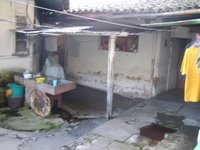
Our travel alarm clock rang at 6am. I swiftly jumped out of bed from under the toasty covers and pulled a sweatshirt over my night gown and put on a pair of capri pants. (very cute visual!) I grabbed our community towel and headed across the courtyard. No problem.
I entered the bathroom where all toilet paper and feminine hygiene products must be disposed of in the waste basket. I entered the curtained shower area and began to derobe--leaving my sandals on. (it was like freshman year all over). This was a piece of cake. So, I turned the knobs to start the water flow and desperately watched two drops slowly fall to the ground. No agua! Why did I volunteer to shower first?
I reclothed and found Martha and in my limited Spanish exclaimed, "No Agua!" She smiled knowingly and led me back to el bano. There she grabbed a box of matches off of the water tank, walked to a box on the wall, and lit what appeared to be the equivalent of a pilot light on a stove. She then smiled and went into the area with the toilet and turned a valve to the left.(ah! a main water source!). Finally, she turned the knobs and glorious streams of hot water poured out of the shower head. I finished my shower and treked back to our room; I was perfectly content with the outcome of my first daily task. Hmmm, now I had to brush my teeth.
Monday, July 10, 2006
Well that was easy!
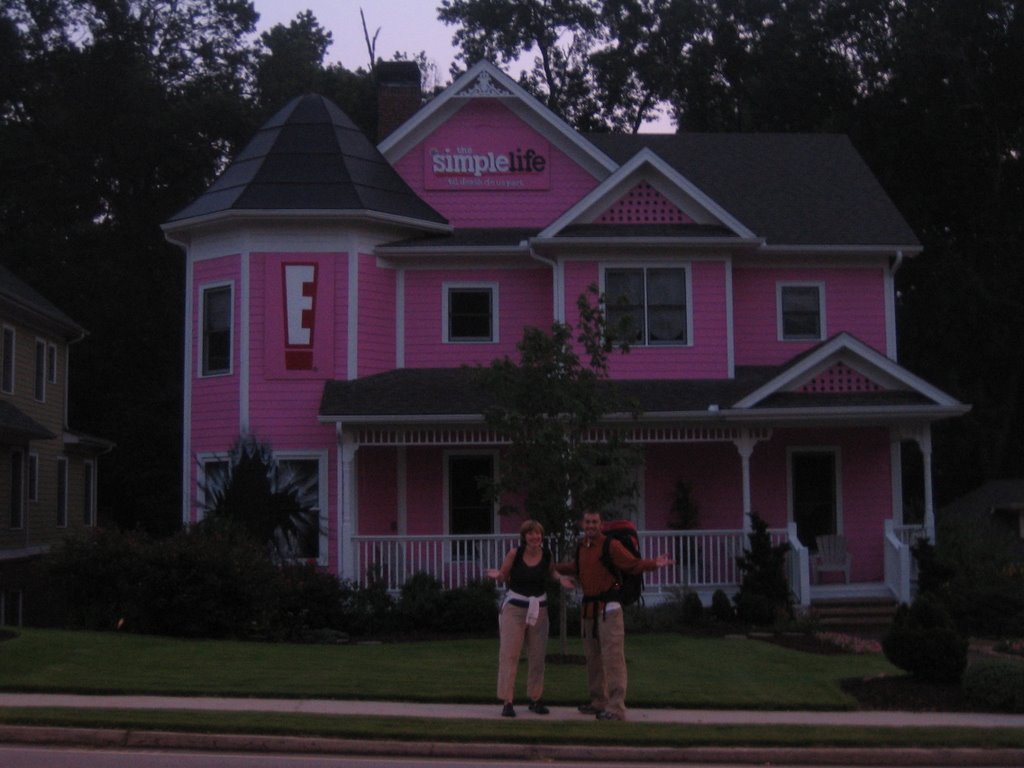

We debated our options only to realize our tickets were non-refundable. Maybe next season we'll join in. But for now, we'll leave the Simple Life to the feuding duo and keep working on our pilot for a Central American spin-off of "Till Death Do Us Part".
Sunday, July 09, 2006
We're off to live the Simple Life
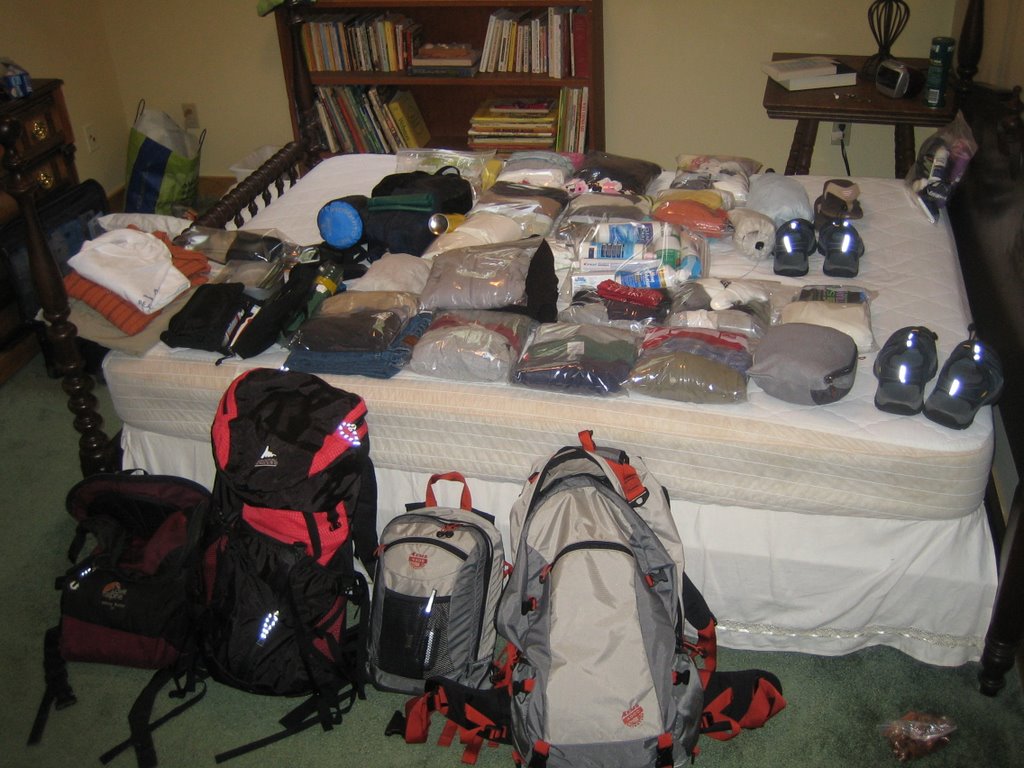
No really, we're not kidding...
These are our lives in backpacks:
- Three pants
- two shorts
- three shirts
- two long sleeve shirts
- few tank tops
- fleece
- few socks and underwear
- one dress (for Liz)
- swimsuit
- raincoat
- umbrella
- keens (+ foot deoderant for Bert)
- sneakers
- LOTS of tampons
- deet-filled bug spray & mosquito net (PROTECTION)
- condoms (even more protection...keep waiting Ian)
- water purifier (cutting edge stuff...unless it DOESN'T WORK!!!)
- medications & medical stuff (yes, we're prepared for the inevitable intestinal warfare)
- hat
- sun glasses
- books
- travel guide
- camera
- journal(s)
Things that didn't make the cut:
- house
- car
- computer
- cell phone
- ipod
- PDA
- wedding ring
- straight iron ( I hear frizzy hair is all the rage in Guatemala)
- Liz's 6 other pair of shoes
- half the underwear (thanks for the tip, Tim)
- few shirts and shorts (don't worry, Bama love will be spread)
- calming body lotion (what do we have to be stressed out about...we're unemployed!)
So here we lie in bed on this, our last night in the country for over 5 months. We have the expected feelings: excitement, anxiety, love, irritability ("Bert, it's LATE"), freedom, liberation, fulfillment, love ("seriously Robert, we have to be up at 5am"), and did I mention irritability? ;-)
You get the point!
What's next? Good question. Stay tuned...
Monday, July 03, 2006
We've ESCAPED!
At least from New York.
We're enjoying a week of family in the mountains of western NC before heading out next Monday, July 10 to Guatemala. Our minds are slowly accepting what our bodies have been craving -- some good ole' fashion R&R!
While in many ways the trip seems surreal, it is increasingly real with each passing thought. It's slowly sinking in -- what we've been talking about and planning for the past two years we are now living. This isn't just our annual trip to Montreat for 4th of July celebrations, but the beginning of a life altering adventure.
We have surprisingly few expectations and pre-conceived notions of what to expect on this journey. Sure, we've read the guidebooks and scoured the internet for tidbits of information and advice. But we've embraced our uncertainty. There's an overwhelming sense of calm knowing that we are on this journey together.
So The Great Escape begins. And as with all escapes, there will surely be implications and maybe even consequences.
Or so we hope...
-Liz & Robert
We're enjoying a week of family in the mountains of western NC before heading out next Monday, July 10 to Guatemala. Our minds are slowly accepting what our bodies have been craving -- some good ole' fashion R&R!
While in many ways the trip seems surreal, it is increasingly real with each passing thought. It's slowly sinking in -- what we've been talking about and planning for the past two years we are now living. This isn't just our annual trip to Montreat for 4th of July celebrations, but the beginning of a life altering adventure.
We have surprisingly few expectations and pre-conceived notions of what to expect on this journey. Sure, we've read the guidebooks and scoured the internet for tidbits of information and advice. But we've embraced our uncertainty. There's an overwhelming sense of calm knowing that we are on this journey together.
So The Great Escape begins. And as with all escapes, there will surely be implications and maybe even consequences.
Or so we hope...
-Liz & Robert
Monday, June 19, 2006
It's the media, stupid
Media Matters - "Media Matters"; by Jamison Foser
"Media Matters"; by Jamison Foser
Weekly Part 4: where do we go from here?
Three weeks ago, we began what has now turned into a four-part series:
The defining issue of our time is not the Iraq war. It is not the "global war on terror." It is not our inability (or unwillingness) to ensure that all Americans have access to affordable health care. Nor is it immigration, outsourcing, or growing income inequity. It is not education, it is not global warming, and it is not Social Security.
The defining issue of our time is the media.
The dominant political force of our time is not Karl Rove or the Christian Right or Bill Clinton. It is not the ruthlessness or the tactical and strategic superiority of the Republicans, and it is not your favorite theory about what is wrong with the Democrats.
The dominant political force of our time is the media.
Top 10
This is worth a few chuckles...
The Top 10 Conservative Idiots - The Top 10 Conservative Idiots, No. 248
The Top 10 Conservative Idiots - The Top 10 Conservative Idiots, No. 248
Subscribe to:
Comments (Atom)